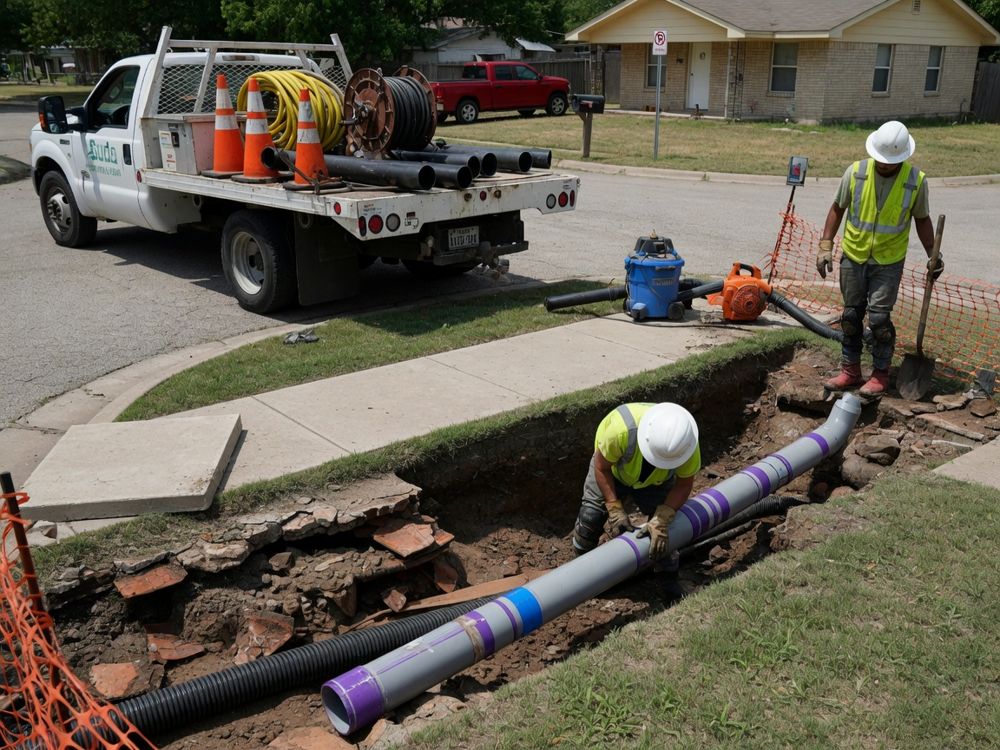
Drain repair is for the pipe, not the clog. When a drain keeps backing up after it has been cleaned, the pipe itself is often damaged: a cracked section, a joint that has separated, a low spot where water and waste settle, or roots that have worked into a seam. Each of these catches waste and paper, and each one comes back after a simple cleaning.
Drain lines carry wastewater from every fixture to the main line and out to the sewer connection. Damage can sit under a slab, beneath a driveway, inside a wall or out in the yard, so repair starts with finding exactly where and why the line is failing.
In parts of Hays County the soil contains expansive clay, which swells when wet and shrinks when dry. Over many seasons that movement can stress buried pipes and joints. Conditions vary between neighborhoods and even between neighboring lots, so the reliable way to know what is happening to your line is to look inside it.
Signs you may need drain repair
- Backups that return soon after cleaning
- Slow drains in more than one fixture
- Gurgling from drains or toilets when other fixtures run
- A sewage smell indoors or in the yard
- Wet, sunken or unusually green patches of yard along the line
- A camera inspection that shows cracks, offsets, roots or sags
Common causes
Tree roots
Roots seek moisture. They enter through small cracks and loose joints, then grow into a mass that narrows the pipe and catches debris.
Shifting soil
Expansive clay swells when wet and shrinks when dry. Repeated movement can pull joints apart or crack a pipe over time.
Aging or corroded pipe
Older materials such as cast iron and clay tile can corrode, crack or separate at the joints with age.
Sags in the line
A section that has settled holds water and waste, so debris builds up in the same spot every time.
Joint separation
Joints that pull apart let soil and roots in and let wastewater out.
Outside damage
Digging, heavy equipment or loads over a shallow pipe can crack or crush it.
Drain repairs we handle
Broken drain pipe repair
A fractured or crushed section is cut out and replaced. In many cases only that section needs to come out. The repair depends on the pipe material, its depth and what is above it, such as a slab, a driveway or landscaping.
Offset and separated joint repair
When two pipe sections no longer line up or have pulled apart, the joint is corrected so waste passes smoothly and soil and roots stay out.
Sag (belly) correction
A low spot in the line is exposed and the pipe is reset at the right slope so water carries waste along instead of leaving it behind.
Root-damaged pipe repair
Roots are removed and the pipe is repaired where they entered, so they do not simply grow back.
Collapsed section replacement
Where a pipe has collapsed, the failed length is replaced. A camera shows how far the collapse extends.
Underground drain repair
Buried drain lines under a yard, a driveway or a slab are repaired at the damaged section once a camera has shown where it is. How much digging is needed depends on the depth and what is above the pipe.
Drain pipe replacement
When damage is widespread or a pipe has failed in several places, replacing a longer run can be more sensible than repeated spot repairs. The camera findings decide it.
Cleanout access
Where a line has no cleanout, adding one during a repair, where practical, makes future cleaning and inspection simpler.
What you need to do before we arrive
Stop using the affected drains
Every gallon sent into a damaged line can leak out at the break or push waste back up.
Write down what you have noticed
Which fixtures, when it started, any gurgling or smells, and anything that changed recently such as heavy rain or tree work.
Find your main cleanout
It is usually a capped pipe outside near the house or in a garage or basement. Knowing where it is speeds up the visit.
Clear access
Move vehicles, furniture and storage away from the cleanout and from any area where work may be needed.
Call 811 before any digging of your own
Utility lines are buried too. If you plan to dig anywhere near the line, call 811 first.
Gather background
The approximate age of the home, any earlier drain work and any trees removed or planted near the line.
How drain repair works in Buda, TX
Call and describe the problem
Tell us which drains are affected and what you have seen. That tells us whether we are likely looking at a fixture, a branch line or the main line.
Inspect the line
Where it is warranted, we run a camera through the line and note what we see and where.
Review the findings and options
We explain what is wrong and the options: a spot repair, a longer replacement, or in some cases cleaning with monitoring.
Complete the repair
We repair or replace the damaged section as agreed.
Check the result
We confirm water flows freely through the repaired section and tell you what to watch for.
What to avoid, and how to prevent repeats
Avoid
- Pouring chemical drain cleaner into a line you suspect is damaged. It can sit in the break and harm the pipe and whoever works on it next.
- Running a cable again and again through a line with a break. It can snag on the damage and make it worse.
- Ignoring wet or sunken ground along the line.
- Digging without calling 811 first.
- Planting trees or large shrubs directly over a known drain or sewer line.
To prevent repeats
- Keep grease, wipes and other non-flushables out of the drains.
- Plant trees and large shrubs away from buried lines.
- Fix small signs early. A slow drain that keeps returning is easier to deal with than a full backup.
- In an older home, consider a camera inspection before problems appear.
What drain repair typically costs
| Job | Typical range | Real cost |
|---|---|---|
| Minor, accessible drain repair | $250 - $900 | Call for an estimate |
| Spot repair on a buried line | $1,200 - $4,500 | Call for an estimate |
| Longer section replacement | $3,500 - $12,000+ | Call for an estimate |
These ranges are general guides only and are not a quote. The actual cost depends on the pipe, the access and the cause, so call for an estimate.
What changes the price
- Pipe material and size
- Depth of the line
- Length of the damaged section
- Access: under a slab, a driveway or landscaping
- Number of problem spots found
- Surface restoration needed after the repair